

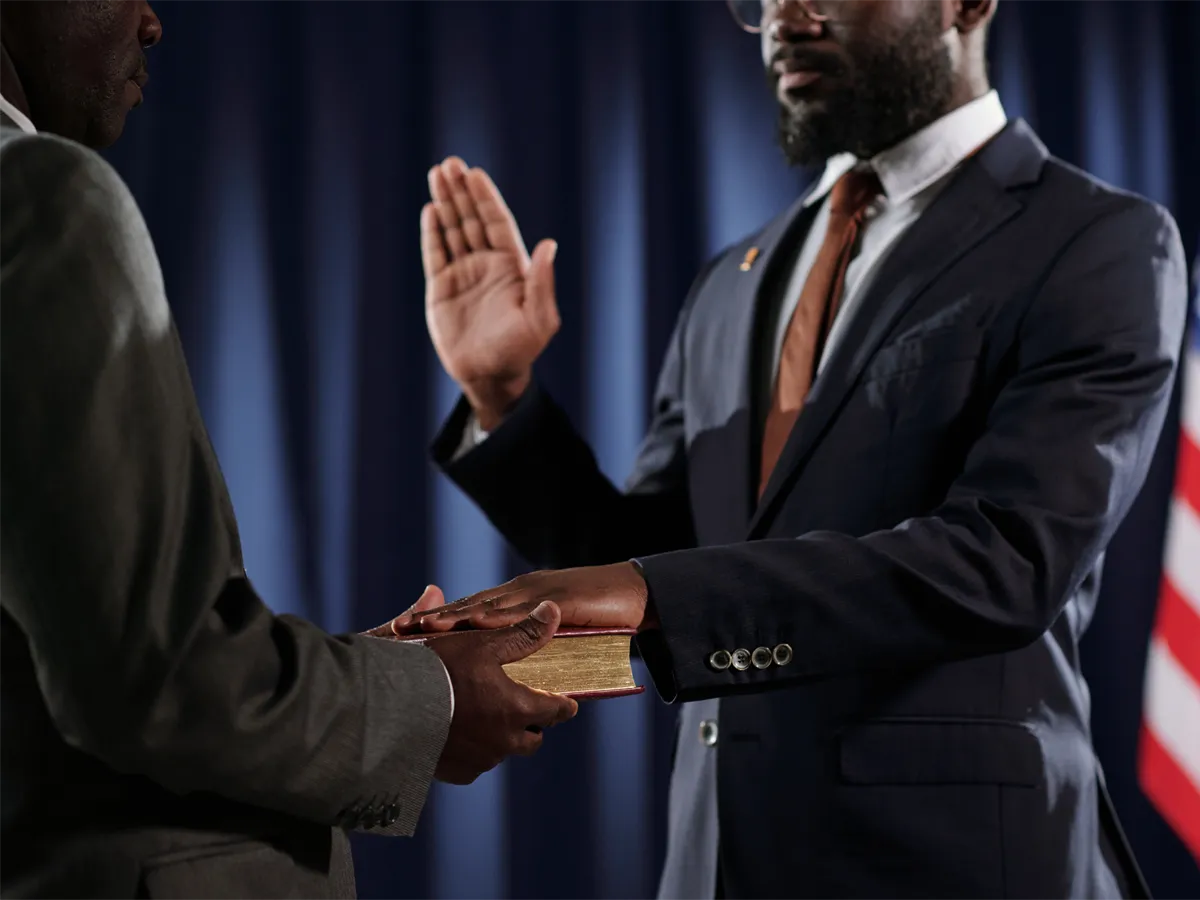
Taking the Oath of Allegiance to the United States is the final, mandatory step to becoming a U.S. citizen.
Even if you have passed your civics test and naturalization interview, you will not receive your Certificate of Naturalization until you complete it.
By taking this oath, you commit to fulfilling the following duty:
- Support and defend the Constitution and laws of the United States against all enemies, foreign and domestic.
- Renounce any allegiance to another nation or sovereign, including any hereditary or noble titles.
- Perform military or civilian service when requested by the government.
- Serve in a noncombatant capacity within the Armed Forces if you are unable to bear arms.
- Perform work of national importance under civilian direction when necessary.
Oath of Allegiance to the United States: Current version
During the citizenship ceremony, the officer will ask you to stand and raise your right hand to take the oath.
The officer will recite the oath, and you must repeat it aloud.
“I hereby declare, on oath, that I absolutely and entirely renounce and abjure all allegiance and fidelity to any foreign prince, potentate, state, or sovereignty, of whom or which I have heretofore been a subject or citizen;
… that I will support and defend the Constitution and laws of the United States of America against all enemies, foreign and domestic;
…that I will bear true faith and allegiance to the same;
…that I will bear arms on behalf of the United States when required by the law;
…that I will perform noncombatant service in the Armed Forces of the United States when required by law;
…that I will perform work of national importance under civilian direction when required by the law; and
…that I take this obligation freely, without any mental reservation or purpose of evasion; so help me God.”
What are you committing to when you take the Oath of Allegiance?
By reciting the oath, you are legally assuming four fundamental commitments:
1. Renouncing all foreign allegiance
You renounce all loyalty and fidelity to any foreign prince, state, or sovereignty, as well as any noble titles you may hold.
This does not mean you must give up your original citizenship. Current U.S. law recognizes dual citizenship with other countries.
However, this oath requires you to be exclusively American in the eyes of the federal government. If a conflict of interest arises with another country—even your country of birth—your primary and legal loyalty belongs to the United States.
2. Loyalty to the Constitution and U.S. laws
First, you acknowledge the U.S. Constitution as the ultimate authority. And you promise to obey it and refrain from any action that undermines the constitutional order.
You also accept U.S. laws as the ultimate standard by which you will conduct yourself, even if they differ from the laws and customs of your home country.
Finally, you commit to defending the Constitution and the law against “foreign and domestic” enemies.
This means that, if the United States were attacked by a foreign power or an internal group, you would not join them. Instead, you would remain firmly on the side of the law.
3. Military or civilian service upon request
You swear that you are ready to defend the country during a conflict or national emergency actively. This includes your willingness to bear arms and join a military conflict if the law requires it.
Or serve in administrative, medical, or logistical roles in the Armed Forces, helping in a noncombatant capacity.
4. Performing work of national importance
You commit to “performing work of national importance under civilian direction when required by the law.”
U.S. citizenship carries the responsibility that, if the government deems it vital during a crisis, you may be required to perform non-military civilian tasks.
Currently, there is no law requiring citizens to perform such forced labor. However, by taking this oath, you are agreeing to comply should such a requirement be implemented in the future.
Who Must Take the Oath of Allegiance?
According to Section 337 of the Immigration and Nationality Act (INA), every adult who applies for naturalization must take the oath.
It is the final legal requirement to obtain U.S. citizenship. Without it, the naturalization process is legally incomplete.
However, the law provides specific statutory exceptions that exempt an applicant from this step.
- Children who are too young to understand the meaning and responsibility of the oath.
- Applicants with medical conditions that prevent them from understanding or communicating their commitment. In these cases, the law presumes that the individual possesses the required attachment to the principles of the U.S. Constitution.
If you fall into this category, you must declare your disability when completing Form N-400 (Section 9).
You must also provide strong medical evidence, such as official certificates and a detailed medical history, at your interview.
Can you modify the Oath of Allegiance?
Although the standard procedure requires reciting the full text, the U.S. legal system permits omitting or modifying specific phrases.
There are three primary ways to modify the oath based on your personal circumstances:
1. Language and communication adaptations
If you qualify for an English language waiver, you may take the oath of allegiance in your native language.
These exceptions are based on your age and how long you have been a permanent resident. They are commonly known as the 50/20, 55/15, and 65/20 rules.
You may also qualify for a waiver if you have a physical or mental disability that prevents you from learning English.
In these cases, you may bring an interpreter or legal representative to your ceremony to translate the oath for you.
2. Conscientious objection to bearing arms
If your convictions prevent you from swearing to “bear arms” in defense of the country, you may request a modification.
To do so, you must provide clear and convincing evidence that your opposition stems from your religious training and beliefs.
This conviction must be sincere, not based on purely political, sociological, or personal moral codes.
3. Removing religious references
The United States guarantees your right to practice any religion—or none at all. If you are an atheist or agnostic, or if you prefer a secular declaration, you may request the following changes:
- Replace “on oath” with “I solemnly affirm.”
- Remove the final phrase, “So help me God.”
You only need to inform the USCIS officer of this request during your citizenship interview. You are not required to provide personal reasons for this request, and by law, the officer cannot reject it.
What is the next step after the Oath?
After taking the Oath and receiving your certificate, you are a full American citizen. You can then enjoy all the rights and benefits of citizenship.
Although the naturalization process is over, you still have a few tasks to complete:
- Applying for a U.S passport
- Updating your Social Security Number (SNN)
- Registering to vote