

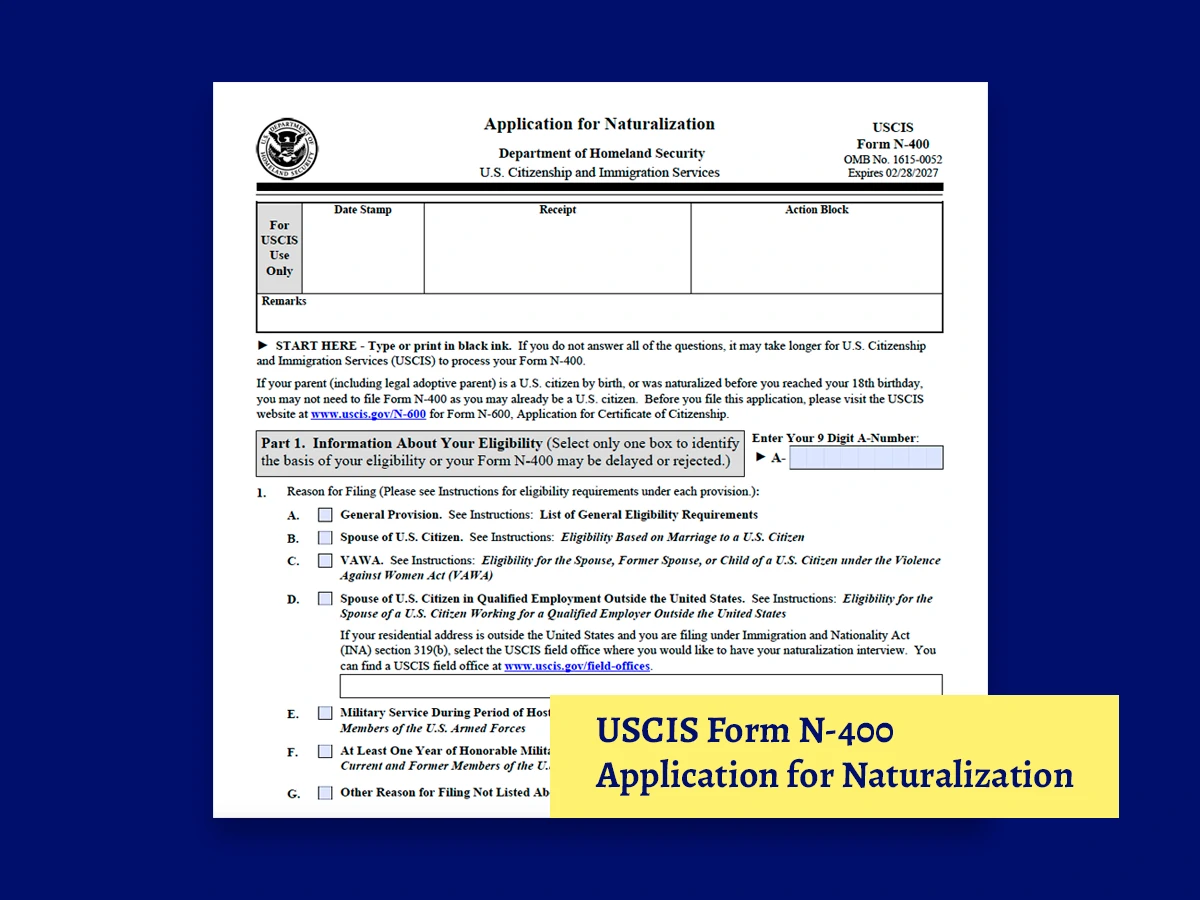
Ready to apply for U.S. citizenship? This guide will walk you through filling out the N-400 form, section by section.
Our goal is to help you file your application without technical errors that could lead to delays or rejections by USCIS.
How should you submit Form N-400? Online or by mail?
There are two official ways to file Form N-400: online or by mail.
Both are valid, though USCIS recommends using the MyUSCIS online portal. This method is easier and faster, and you can save money on the N-400 filing fee.
| Feature | Online filing | Paper filing (Mail) |
| Prerequisite | Create an account at my.uscis.gov | Download the official PDF from the USCIS website. |
| How to Fill It Out | Directly in your browser, step-by-step. | On your computer (fillable PDF) and print it, or print and fill it by hand. |
| Evidence | Scan and upload digital files. | Attach physical photocopies to your packet. |
| Cost (2026 Fee) | $710 | $760 (Standard full fee). |
| Submission Confirmation | Instant. The portal gives you a receipt the moment you pay. | None until your envelope is processed. |
| Receipt Number | Appears in your account after system validation (“Documents” tab). | Sent via physical mail (I-797) within 2–4 weeks. |
| Signature | Digital signature (typing your full name). | Physical signature in black ink (mandatory). |
How to fill out the N-400 Form: Application for naturalization
Now, we will go through everything you need to include in your N-400 form section by section.
First, here are a few tips to help you get started:
- Read the USCIS instructions before filling out your N-400.
- Make sure you are using an updated version that hasn’t expired. For 2026, use the version valid through February 28, 2027.
- Gather all the necessary documents so you can fill out your application with exact information. These include your Green Card, birth certificate, marriage certificate, and current and old passports.
- If you are filling out the form by hand, use black ink and print clearly in block letters.
- While writing in ALL CAPS is not mandatory, it is highly recommended to reduce the chance of errors and make your form easier to understand.
- Write your A-number on every page of the N-400 form. It consists of 9 numbers, and you must include all of them (e.g., A-345678912).
- If your number has fewer digits, say seven, put zeros at the beginning to fill the nine spaces (e.g., A-003456789).
- Answer every question on the N-400 form.
- Write “N/A” if a question does not apply to your situation.
- Use “NONE” if the answer is zero.
- You may leave a question blank if it truly does not apply.
- Answer every N-400 form question honestly.
- Be consistent with your previous immigration filings, as they may be reviewed as well.
Instructions for filling form N-400: Step-by-step
Part 1: Information about your eligibility
In this section, specify the exact basis for your U.S. citizenship application. You have several options:
- Box A: If you have been a lawful permanent resident (green card holder) for at least five years.
- Box B: If you are married to a U.S. citizen and have been a lawful permanent resident for at least three years.
- Box C: You obtained your green card through a U.S. citizen parent or spouse and suffered extreme cruelty or battery. This allows you to naturalize under the spousal provision even if you are not currently living with your spouse.
- Box D: If you are married to a U.S. citizen who works for a qualifying employer outside the U.S.
- Box E: If you served on active duty or in the Selected Reserve or Ready Reserve of the U.S. Armed Forces during a designated period of hostilities.
- Box F: If you have at least one year of honorable service in the U.S. Armed Forces.
It is vital that you carefully review the requirements for each box and check the box that best identifies your situation. Checking more than one box or leaving one blank may result in a delayed or rejected Form N-400.
Part 2: Information about you
1. Current legal name
Provide your full legal name exactly as it appears on your green card or birth certificate.
2. Other names used since birth
List any other names you’ve had here. This applies if you have changed your name through marriage or a court order. If this doesn’t apply, leave this field blank or write “N/A.”
Include aliases, maiden names, birth names, assumed names, nicknames, alternate spellings, and variations.
Note: We aren’t talking about casual nicknames your family uses at home. These must be variations that you have used on official documents.
3. Name change (Optional):
As part of the naturalization process, you can legally change your name. This is a huge perk because your Naturalization Certificate will be issued with your new name, and you won’t have to pay extra for the change.
However, it may delay the processing time of the N-400 form.
Name changes require judicial approval, so you will need to attend a judicial ceremony presided over by a judge. These ceremonies are less common than administrative ones.
If you are set on changing your name, check this box and enter your new name.
4. USCIS online account number
Enter your number here if you already have a MyUSCIS online account. This will link this application to your profile, allowing you to receive direct notifications, check your status, and upload evidence.
Learn more: What is USCIS online account number
5. Sex
Indicate your sex as it appears on your birth certificate, green card, or driver’s license.
If you have undergone a gender transition, you must provide a court order for the gender and name change, as well as medical records.
6. Date of birth
Enter your exact birth date. Use the MM/DD/YYYY format.
Note: In the U.S., the month always comes first on this form.
7. Date you became a lawful permanent resident
Look at your green card and enter the exact date listed under “Resident Since.” Use the MM/DD/YYYY format.
It is extremely important to enter the date correctly. Keep in mind the rules for continuous residence and physical presence.
8. Country of birth
9. Country of citizenship or nationality
If you have more than one nationality, list the additional ones in Section 14 (Additional Information), along with the dates you acquired them.
Before applying, check if your home country allows dual citizenship. Some countries do not allow it, and you may need to renounce your current citizenship to become a U.S. citizen.
10. Citizenship of parents
Indicate whether either of your parents became a U.S. citizen before you turned 18.
11. Disabilities and/or impairments
Indicate here if you have a disability that would prevent you from taking the citizenship test (either the English portion, the civics portion, or both).
If so, include Form N-648, completed and signed by an authorized medical doctor, with your application.
Social Security update
This section was originally designed to grant USCIS permission to share your data with the Social Security Administration (SSA) for automatic status updates.
While this was advantageous for applicants, USCIS reported system issues communicating with the SSA in 2025. So they are no longer automatically handling this update.
This means that once you complete the process, you will likely need to visit the SSA in person to update your status to “citizen.”
However, just in case, select “Yes” to provide your consent.
You must also provide your Social Security number in this section.
Part 3: Biographical information
In this section, you must describe your physical traits.
- Ethnicity
- Race: You may select more than one category.
- Height: In feet and inches.
- Weight: In pounds.
- Eye color and hair color.
Except for hair color and weight, which can change over time, use the information on your driver’s license to complete your N-400. form.
Part 4: Information about your residence
Start by providing your current physical address:
- Street name and number
- City or town
- State
- Zip code
- Province, postal code, and country (if applicable).
- Enter the exact date you started living at this location.
Below that, you will find a table to list every address where you have lived in the last five years (three years if you are filing based on marriage).
Details: Make sure your “move-in” and “move-out” dates align perfectly. USCIS looks for gaps. Ensure there are no unexplained gaps of a month or more.
If you do not want USCIS to send mail to your current physical address, select “No” and provide a secure mailing address.
Part 5: Information about your marital history
Everyone applying under the 5-year or 3-year rule must complete this section thoroughly.
- Current Spouse: Provide their full name, date of birth, and place of employment.
- Marriage Date: Verify the date on your marriage certificate.
Count every marriage, including annulled marriages and religious ceremonies, even if they weren’t officially registered. If you marry the same person twice, each marriage counts as a separate union.
If you are applying based on marriage, you must attach divorce decrees or death certificates for any prior marriages (for you and your current spouse) to prove that your current marriage is legal.
If you are applying under the five-year rule, you do not need to send these documents now, but you must bring them to your citizenship interview.
Part 6: Information about your children
You must include all of your children, without exception.
- Children born in the U.S. or abroad.
- Stepchildren.
- Legally adopted children.
If your children are minors and do not live with you, you must provide evidence that you are meeting your child support obligations. This applies even if your children live in another country.
This is essential to prove your good moral character. Gather receipts, bank statements, or letters from the other parent showing that you are providing financial support.
Part 7: Employment and schools attended
List everything you have done in the last five years (three if applying by marriage).
- Include all periods of employment and schooling. Always start with your most recent activity and work backward.
- If you were unemployed, retired, a homemaker, or self-employed, include that information. If you need more space, attach an extra sheet.
- Provide the company name, address, and exact start and end dates.
Part 8: Time outside the United States
This is one of the most critical sections. USCIS must verify your continuous residence and ensure that no long trips have interrupted this period.
- Only record trips that lasted more than 24 hours.
- Only list trips taken after you became a lawful permanent resident.
- Use your passport stamps and flight tickets to determine your exact entry and exit dates.
- If you became a resident while traveling, only count the days you were away as a green card holder.
- For instance, if you became a resident on May 30 and were traveling from May 20 to June 1, you would only count the two days from May 30 to June 1.
- We strongly recommend consulting an attorney if your trip lasts 6 months or more. You may have interrupted your continuous residence, which could mean you have to wait longer to qualify.
Part 9: Additional information (The “Yes or No” questions)
This section is arguably the most important part of the entire form. These “yes or no” questions determine how USCIS evaluates your good moral character.
For a “clean” application, you should answer:
- No: to questions 1–30 (except for the Selective Service and U.S. Armed Forces questions, if applicable).
- Yes: to questions 31–37 (unless question 33 about physical or mental condition that would prevent you from taking the oath.).
However, you must answer honestly. Never hide information or lie. USCIS cross-references your data with other government agencies. If they detect a lie, you may be disqualified automatically.
- Criminal Records/Fines: List any criminal records or traffic tickets you have. USCIS values honesty and rehabilitation.
- Debts: If you owe taxes or child support, declare them and provide a plan showing how you are paying those debts back.
We strongly advise you to seek legal help if you have to answer “yes” to any questions about arrests, crimes, or financial defaults.
Part 10: Request for fee reduction
You may qualify for a reduced filing fee if your household income is at or below 400% of the Federal Poverty Guidelines.
If you are applying for a full fee waiver, you must file Form I-912 with your N-400 application. This is a separate step that requires specific financial documentation to prove eligibility.
Part 11: Contact information, certification, and signature
Enter your primary phone number and email address. Double-check these entries! This is how USCIS will contact you.
Although most official communication happens via physical mail, it is crucial to provide a correct phone number and email address for status updates or interview scheduling.
Once you have finished, remember to sign your application in black ink. An unsigned form will be rejected automatically.
Parts 12 and 13: Interpreter and preparer information
Complete these sections only if someone helped you fill out your Form N-400.
Part 14: Additional Information
Use this section to provide any additional information that did not fit in the previous sections. Use it to list more nationalities, previous addresses, or employment history.
When adding information here, clearly state the page, part, and item numbers you are referring to.
As with every other page, write your A-Number at the top of these sheets.
Parts 15 and 16: The interview and oath of allegiance
Do not fill out these sections. Leave them blank until your naturalization interview.
You will only sign these in the presence of a USCIS officer during your interview and subsequent Oath of Allegiance ceremony when they instruct you to do so.
FAQs
Where should I submit my Form N-400?
Where you send your Form N-400 depends on whether you’re filing the N-400 online or by mail. If you file online, simply upload your documents through the USCIS platform. If you prefer to mail it, check the USCIS address list.
How long does it currently take to process the N-400?
The current processing time for Form N-400 is up to 6 months. However, this may vary depending on the local USCIS office handling your case.
What should I do if I move after filing my Form N-400?
If you change your address after filing your N-400, you must notify USCIS. You have up to 10 days after you move to do this. This is important to avoid missing important updates to your case.
Can I travel outside the U.S while my N-400 is being processed?
Yes, you may travel outside the U.S while your naturalization application is being processed. However, your total time abroad should not exceed 90 days in 180 days. Also, ensure you do not miss any USCIS appointments, such as biometrics, citizenship exam or interview.
Not sure how to write N/A in N-400 when boxes are yes or no only…